
Vehicle characteristics
4WD system (if equipped)
Your vehicle may be equipped with a four-wheel drive (4WD) system.
With the 4WD option, power will be delivered to the front wheels and distributed to the rear wheels as needed. This increases traction which may enable you to safely drive over terrain and road conditions that a conventional two-wheel drive vehicle cannot. The 4WD system is active all the time and requires no input from the operator.
For 4WD vehicles, a spare tire of a different size other than the tire provided should never be used. A dissimilar spare tire size (other than the spare tire provided) or major dissimilar tire sized between the front and rear axles could cause the 4WD system to stop functioning and default to front-wheel drive.
 WARNING:
Do not become overconfident in the ability of 4WD vehicles. Although a 4WD vehicle
may accelerate better than a two-wheel drive vehicle in low traction situations,
it won’t stop any faster than two-wheel drive vehicles. Always drive at a safe speed.
WARNING:
Do not become overconfident in the ability of 4WD vehicles. Although a 4WD vehicle
may accelerate better than a two-wheel drive vehicle in low traction situations,
it won’t stop any faster than two-wheel drive vehicles. Always drive at a safe speed.
How your vehicle differs from other vehicles
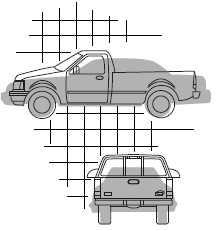
SUVs and trucks can differ from some other vehicles in a few noticeable ways. Your vehicle may be:
• Higher – to allow higher load carrying capacity and to allow it to travel over rough terrain without getting hung up or damaging underbody components.
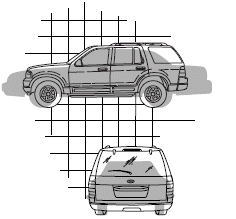
• Shorter – to give it the capability to approach inclines and drive over the crest of a hill without getting hung up or damaging underbody components. All other things held equal, a shorter wheelbase may make your vehicle quicker to respond to steering inputs than a vehicle with a longer wheelbase.
• Narrower – to provide greater maneuverability in tight spaces, particularly in off-road use.
As a result of the above dimensional differences, SUVs and trucks often will have a higher center of gravity and a greater difference in center of gravity between the loaded and unloaded condition.
These differences that make your vehicle so versatile also make it handle differently than an ordinary passenger car.
See also:
Engine coolant check
Checking the Engine Coolant
The concentration and level of engine coolant should be checked at the intervals
listed in Scheduled Maintenance Information.
Note: Make sure that the level is between ...
Parking Aids
Sensing system
WARNING: To help avoid personal injury, please read and understand the
limitations of the system as contained in this section. Sensing is only an aid for
some (generally large and ...
Active Park Assist (APA) (If equipped)
Active park assist (APA) will detect an available parallel parking space and
automatically steer the vehicle into the space (hands-free) while you control the
accelerator, gearshift and brakes. Th ...