
Head restraints
WARNING: To minimize the risk of neck injury in the event of a crash, the driver and passenger occupants should not sit in or operate the vehicle, until the head restraint is placed in its proper position. The driver should never adjust the head restraint while the vehicle is in motion.
WARNING: The adjustable head restraint is a safety device.
Whenever possible it should be installed and properly adjusted when the seat is occupied.
WARNING: Install the head restraint properly to minimize the risk of neck injury in the event of a crash.
Note: Before adjusting any head restraint, adjust the seat back to an upright driving or riding position. Properly adjust the head restraint so that the top of the head restraint is even with the top of your head and positioned as close as possible to the back of your head. For occupants of extremely tall stature, adjust the head restraint to its full up position.
To adjust the head restraint, do the following:
Front Seat and Rear Seat Outboard Head Restraints
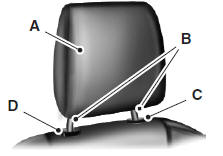
Note: The center rear head restraint is fixed and non-adjustable.
The head restraint consist of a trimmed foam covering over the upper structure of the seatback.
The head restraints consist of :
A. An energy absorbing head restraint
B. Two steel stems
C. Guide sleeve unlock and remove button
D. Guide sleeve adjust and release button
• Raise: Pull up on the head restraint (A).
• Lower: Press and hold the guide sleeve adjust and release button (D) and push
down on the head restraint (A).
• Remove: Pull up the head restraint until it reaches the highest adjustment position
and then press and hold both the adjust and release button (D) and the unlock and
remove button (C), then pull up on the head restraint.
• Reinstall: Align the steel stems into the guide sleeves and push the head restraint
down until it locks.
Tilting Head Restraints (If Equipped)
The front head restraints may have a tilting feature for extra comfort. To tilt the head restraint, do the following:
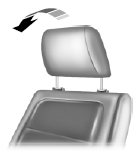
1. Adjust the seat back to an upright driving or riding position.
2. Tilt the head restraint forward by gently pulling the top of the head restraint.
Once it is in its forward-most position, tilt it forward once more to release it to the upright position.
Note: Do not attempt to force the head restraint backward after it is tilted. Instead, continue tilting it forward until the head restraint releases to the upright position.
See also:
Engine coolant
Checking engine coolant
The concentration and level of engine coolant should be checked at the intervals
listed in scheduled maintenance information. The coolant concentration should be
maintai ...
Fuel cut-off switch
WARNING: Failure to inspect and if necessary repair fuel leaks after a
collision may increase the risk of fire and serious injury.
Ford Motor Company recommends that the fuel system be inspected by ...
Controls
Information Display Controls (Type 1)
• Press the up and down arrow buttons to scroll through and highlight the options
within a menu.
• Press the right arrow button to enter a sub-menu.
†...